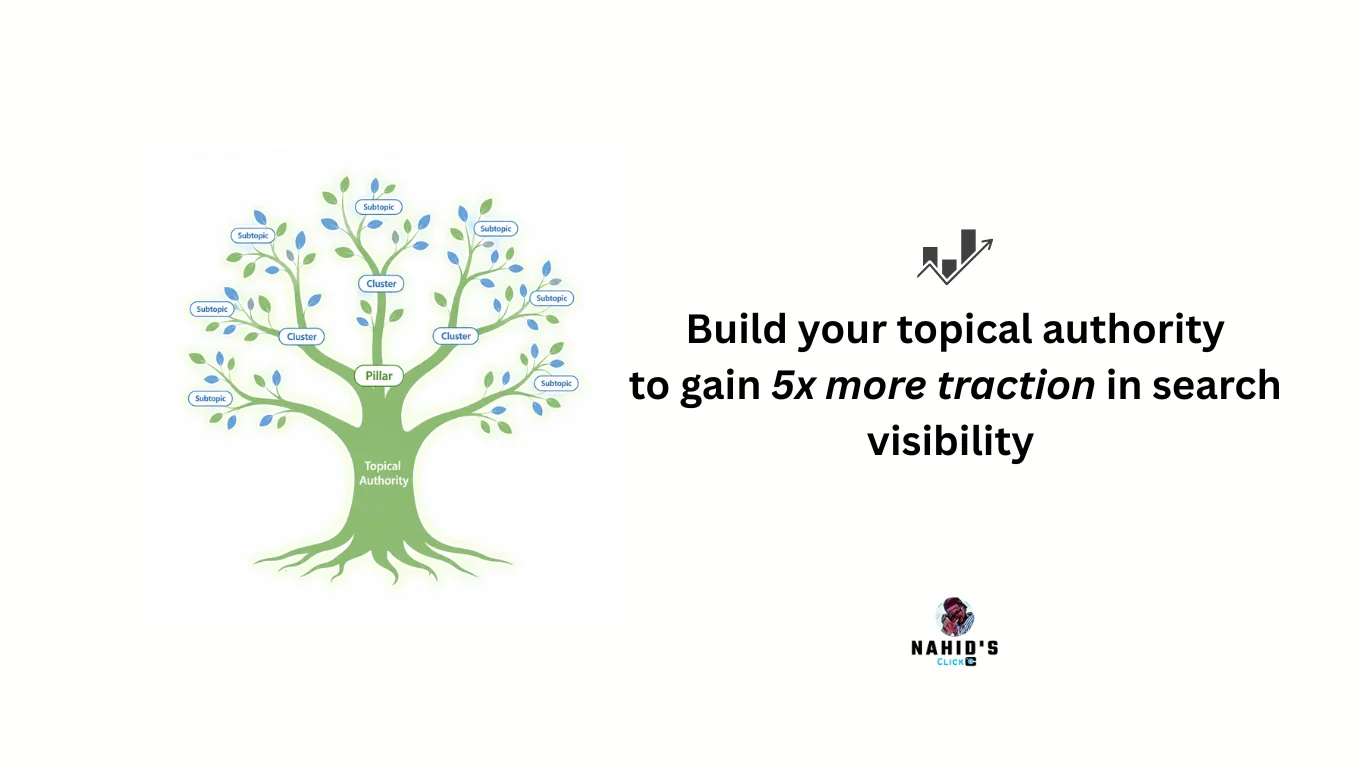
What Is Topical Authority: And How to Build It Before Your Competitors Do
Most sites lose organic traffic, not because they publish bad content. They lose it because they publish disconnected content. Topical authority is the fix, and it’s the one SEO signal AI search makes more important, not less.
I’ve spent 10+ years building content ecosystems for SaaS and WordPress products. At weDevs, I managed content across four products, 700+ articles, 500+ ranking on Google, and 20+ Featured Snippets.
At Arraytics, a cluster-based content strategy drove 70% organic growth in under a year. At FunnelKit, blog traffic grew 25% in four months.
None of that happened by chasing individual keywords. It happened by building topical authority, systematically, cluster by cluster.
Here’s the complete guide to how it actually works.
What topical authority actually is
Topical authority is the degree to which Google trusts your website as the most complete, credible source on a specific subject. It’s not a score. It’s not a plugin setting. It’s a signal Google builds internally by evaluating the depth, structure, and interconnectedness of your content across an entire topic area.
Here’s the distinction that matters: keyword-targeted SEO asks, “Does this page rank for this term?” Topical authority asks, “Does this site own this subject?” The first is a single-page play. The second is an ecosystem play.
Google does not officially use the term “topical authority.” What they measure is semantic depth, entity coverage, content relationships, and E-E-A-T signals at scale. Topical authority is the practitioner label for that combined signal and the strategies that build it are well-documented in Google’s own guidelines and patent filings.
| Signal | Domain Authority | Topical Authority |
|---|---|---|
| What it measures | Overall backlink strength and site popularity | Depth and completeness on a specific subject |
| How it’s built | Acquiring links from other sites | Publishing structured, interlinked content clusters |
| Can you rank without it? | Not reliably in competitive niches | Yes — new sites outrank high-DA domains through topic depth alone |
| Timeline | Months to years | 3–6 months for compounding signal, if cluster threshold is hit |
| AI search impact | Less relevant — AI doesn’t rank by link count | High — AI systems cite topically authoritative sources by default |
Why it matters more in 2026: AI search changes everything
The shift happened gradually, then all at once. AI Overviews now occupy prime SERP real estate. ChatGPT and Perplexity answer questions without sending users to websites. The old playbook of targeting individual keywords and hoping for organic clicks is getting thinner by the month.
Here’s what most SEO guides won’t say clearly: topical authority is your moat against AI search.
AEO / GEO / AI Overview Optimization
Why Topical Authority Is the Answer Engine Signal
AI systems: Google’s AI Overviews, ChatGPT, Perplexity, Claude, pull from sources they’ve internally classified as authoritative on a subject. They don’t rank pages. They cite sources.
A site with established topical authority on WooCommerce conversion optimization is far more likely to be cited than a site with one strong article on the topic.
The mechanism: AI systems use entity graphs and semantic relationships to understand which sources are most complete on a subject.
Topical authority builds that graph in your favor. AEO, GEO, and AI-integrated optimization all converge on one goal: being the source AI trusts, not just the page that ranks.
The entity layer: NLP optimization most guides miss
Google doesn’t read content the way a human does. It maps entities: named people, concepts, tools, processes, relationships, and builds a semantic understanding of what your content is about. Most topical authority guides skip this entirely. It’s the layer that separates content that ranks from content that compounds.
Entities are the nouns in your topic’s semantic universe. For a piece about topical authority, the core entities include:
Topical authority
Semantic SEO
Topic clustering
Hub-and-spoke model
E-E-A-T
Pillar page
Cluster article
Topical map
Gap audit
Hummingbird
Helpful Content System
Topic Share
Internal linking
Entity coverage
Search intent alignment
Domain authority
NLP optimization means ensuring these entities appear naturally throughout your content: not stuffed, but contextually present. Google’s natural language processing maps how these entities relate.
When your content consistently connects related entities across a cluster, the semantic graph becomes denser. That density is part of how topical authority is recognized algorithmically.
Practical NLP Rule
Every cluster article you write should introduce 3–5 new entities while referencing 3–5 entities from the pillar or adjacent cluster pieces. This cross-entity referencing strengthens the semantic graph that Google builds around your site for that topic.
Use Google’s People Also Ask, Semrush’s Topic Research, and AlsoAsked to find the entities your cluster is missing.
E-E-A-T: How it connects to topical authority
Topical authority is the structural outcome of consistently applying E-E-A-T across an entire content ecosystem, not just a single page.
Here’s how each component maps to the content decisions you make:
Experience
Real results from your own execution. Numbers, case studies, and specific outcomes from work you’ve actually done: not generic explanations of how something works.
Expertise
Demonstrated command of the subject. Named authorship, credentials visible on the page, and content depth that signals domain knowledge: not surface-level overviews.
Authoritativeness
External validation in your niche. Backlinks from topic-relevant domains, citations from other authoritative sources, and mentions that signal your content is trusted by peers.
Trustworthiness
Accurate, cited, up-to-date across the entire cluster: not just the flagship piece. Consistent publishing standards signal that the site, not just the page, is reliable.
How to build a topical map in 3 steps
A topical map is your complete content blueprint for a subject area. It covers every parent topic, subtopic, related entity, and user question your audience might search: before you write a single word. This is where most sites skip a step and pay for it later with disconnected content and weak cluster signals.
Step 1: Define the core subject you want to own
Don’t try to build authority on five topics at once. Pick one. It should sit at the intersection of three things: what your audience actively searches for, what your product or service solves, and where you have genuine expertise to bring to the content.
Step 2: Map every subtopic, entity, and question
Use these sources to find every angle:
- Google’s People Also Ask — surfaces real user questions hierarchically
- AlsoAsked.com — maps question trees across related queries
- Semrush Topic Research — clusters subtopics by search volume and intent
- Ahrefs Keyword Explorer — parent topic groupings and keyword difficulty
- Reddit and community forums — real user language that search tools miss
Step 3: Assign intent to every subtopic
Not every subtopic needs the same format. Some deserve comprehensive how-to guides. Some need comparison articles. Some need a short, direct answer. Match the content format to what the searcher actually needs at that moment: this is search intent alignment, and it’s where generic content strategies fail.
The gap audit: Find what’s missing before you write
A topical map tells you what should exist. A gap audit tells you what currently does. Running both together shows you exactly where to direct your content effort for maximum SEO impact.
Here’s a sample gap audit applied to a WooCommerce conversion topic cluster: the same approach I’ve used across client engagements at egenslab.com:
Sample Gap Audit — WooCommerce Conversion Topic
Map your existing content against what the topic actually requires.
Topic Coverage: 12 subtopics mapped
● Covered (5) ● Partial (3) ● Missing (4)
Covered
- What is AOV and why it matters
- How to set up WooCommerce upsells
- Cross-sells vs upsells explained
- Best WooCommerce cart plugins
- Checkout page optimization guide
Partial
- Order bump strategies
- Abandoned cart recovery
- Product page CRO
Missing
- Post-purchase upsell flows
- WooCommerce A/B testing guide
- Conversion tracking setup
- Mobile checkout optimization
The gap audit output gives you a clear, prioritized writing queue. Start with the missing pieces in your highest-traffic subtopics. Then fix the thin/partial content.
Then refresh what’s covered but aging. This sequence produces the fastest topical authority gains. For clients going through this process, I build this audit as part of the full SEO audit workflow.
The 7-step build workflow
This is not a theory. This is the process I’ve used across weDevs, FunnelKit, Arraytics, and ZOYEQ to build content ecosystems that rank without chasing individual keywords. Run this quarterly; each cycle compounds on the last.
Pick One Topic Cluster and Lock In
Don’t build authority on five subjects at once. Pick the topic where search demand, product value, and expertise overlap. Build depth first, then expand.
Build Your Topical Map Before Writing Anything
Map every parent topic, subtopic, related entity, and user question before writing. Without a map, you produce content. With it, you build a system.
Publish Your Pillar Page First
Your pillar page is the anchor for the core topic. It covers the what, why, how, trade-offs, and decision framework. Every cluster article links back to it.
Build Cluster Content That Fills Real Gaps
Cluster content should answer specific questions the pillar introduced but didn’t fully resolve. Keep it focused, useful, and contextually linked.
Scale to 25+ Articles
Aim for at least 25 authoritative, interlinked articles within one cluster. That is where topical authority starts to compound.
Map and Execute Internal Links Systematically
Internal links are semantic signals. Track which article links to which page, and make sure links support real topical relationships.
Refresh Quarterly and Earn Off-Page Validation
Update old content, improve depth, fix gaps, and pursue relevant backlinks from your niche. Authority is maintained over time.
What kills topical authority before it starts
Most sites don’t fail at strategy. They fail at execution discipline. Here’s what breaks the signal before it compounds:
- Publishing breadth without depth. Covering 20 topics shallowly will not build topical authority. Covering one topic thoroughly will. Volume is not the signal; completeness is.
- Skipping internal links. Content without cross-links is invisible to the semantic indexing layer. Google cannot trace the relationship between your articles if you don’t connect them.
- Publishing off-topic content to fill the calendar. Every unrelated piece dilutes the niche signal Google is building for your site. Editorial discipline is part of the strategy.
- Abandoning clusters before hitting the 25-article threshold. The authority signal compounds. Stopping at 12 articles means starting over, not pausing. Momentum matters.
- Generic author bios or no author attribution. E-E-A-T requires named, credentialed human expertise on the page. Anonymous content leaves authoritativeness points on the table, especially in YMYL topics.
- Refreshing on impulse instead of a system. Reactive refreshing misses the outdated pieces that are silently losing rankings. Systematic quarterly audits catch what urgency misses.
How long does it actually take?
Here’s what the data says, not what optimistic SEO case studies say:
For a site starting from scratch, expect 3 to 6 months before the ranking signal compounds noticeably. That assumes you’ve hit the 25-article threshold and internal linking is solid from publication. Sites with existing domain history in a related niche see results faster because the baseline trust is already established.
New domains in competitive niches take longer but can still outrank high-DA sites through topical depth alone. That’s the case study cited repeatedly in SEO research: a new med spa site outranking national high-DA domains on Botox-related queries in three months, purely through cluster depth and entity coverage.
Real Timeline Reference
Growth came from sequencing, not random publishing.
FunnelKit
Blog traffic grew 25% in 4 months through cluster-based publishing.
Arraytics
Organic growth reached 70% in under a year — from 4.1K to 7K monthly clicks.
The growth came through topical mapping and structured content sequences, not keyword-by-keyword targeting. The sequencing matters more than the volume of content you push out.
How to measure topical authority
Topical authority is often called a ghost metric because there’s no single score for it. Here’s how to measure it practically, using what you already have access to:
Topic share (the most useful metric)
Topic Share is the percentage of organic traffic and keyword rankings your site captures within a specific topic area compared to your competitors.
Track this in Ahrefs or Semrush by filtering keyword rankings to your target topic cluster and comparing share of voice over time. This is the measure that shows compounding, as topic share grows month over month, the authority signal is working.
Cluster-level signals in GSC
- Impressions per topic area are more queries in your cluster, triggering impressions?
- Are position trends cluster articles moving from page 3 to page 1 as the cluster grows?
- AI Overview appearances filter GSC search type to see if your content is being surfaced in AI-generated results
The “Keyword Halo” Signal
One clear sign topical authority is working: you start ranking for keywords you never specifically targeted. That’s the halo effect; Google’s understanding of your expertise in a subject starts generating rankings for adjacent queries in your topic space. When you see this in GSC, you know the signal is compounding.
Frequently asked questions
What is topical authority in SEO?
Topical authority is the degree to which Google trusts your website as the most complete, credible source on a specific subject. It’s built by publishing a structured ecosystem of interconnected content pillar pages, cluster articles, and supporting pieces that cover every angle of a topic area. It’s not a score or a single ranking factor. It’s a combined signal made up of semantic depth, entity coverage, E-E-A-T, and internal link architecture.
How is topical authority different from domain authority?
Domain authority measures overall backlink strength and site popularity. It’s a general trust signal calculated by third-party tools like Moz. Topical authority measures how comprehensively your site covers a specific subject area. A site with a low domain authority can outrank a high-DA site through topical depth alone. New sites regularly outrank national brands on specific queries in 3–6 months through cluster depth and entity coverage.
How many articles do I need to build topical authority?
Research consistently points to 25+ authoritative, interlinked articles within one content cluster as the threshold where the topical authority signal starts to compound. Below that, you have coverage. At that point, you have a signal Google trusts, and this is when you start seeing the 40–70% keyword ranking increases that cluster-based strategies produce. Stopping at 12 articles means starting over, not pausing.
What is a topical map?
A topical map is a complete content blueprint for a subject area. It covers every parent topic, subtopic, related entity, and user question your target audience might search for before writing begins. The map tells you what to write, in what order, and what search intent each piece should satisfy. Without it, you produce content. With it, you build a system that compounds.
Does topical authority help with AI Overviews and AI search?
Yes, and this is where it matters most in 2026. AI systems like Google’s AI Overviews, ChatGPT, and Perplexity pull from sources they’ve internally classified as authoritative on a subject. Sites with established topical authority are significantly more likely to be cited in AI-generated responses. Topical authority is the content signal that builds the entity graph AI systems use to determine which sources to trust and cite.
How long does it take to build topical authority?
For most sites, expect 3–6 months before the ranking signal compounds noticeably, assuming you hit the 25-article threshold and internal linking is solid. Sites with existing domain history in a related niche often see results faster. New domains in competitive niches take longer but can still outrank high-DA sites through cluster depth alone. The authority signal compounds over time; consistency matters more than speed.
What is the hub-and-spoke content model?
The hub-and-spoke model is a content architecture where one pillar page (the hub) anchors a topic area, and multiple supporting articles (the spokes) cover specific subtopics in depth. Every spoke links back to the pillar and to other related spokes. This structure signals to Google the semantic relationships between your content pieces and establishes your site as the most complete resource on that subject.
How do I measure topical authority?
The most practical metric is Topic Share, the share of organic traffic and keyword rankings your site captures within a specific topic area compared to competitors. Track this in Ahrefs or Semrush by filtering rankings to your target topic. Secondary signals: number of keywords ranking per cluster in GSC, impressions per topic area trend, AI Overview appearances, and the “keyword halo“, ranking for terms you never specifically targeted.
Keyword-first vs topic-first: So what should your take be?
Keyword-first content strategy made sense in 2015. You found a high-volume keyword, wrote a post targeting it, and waited for traffic. That still works for isolated opportunities. It does not build compounding organic growth, and it does not build the kind of authority that gets your content cited in AI-generated answers.
Topic-first thinking flips the model. You choose the subject area you want to own, map the entire semantic universe around it, and build content that covers every angle a user in that niche might need. The keyword rankings are a byproduct. The authority is the asset.
The sites that dominate AI-driven search over the next three years are not the ones with the highest domain authority scores. They’re the ones Google’s algorithms and the AI systems trained on Google’s understanding recognize as the most complete, trustworthy, and deeply credentialed source on a specific subject.
That recognition is earned, not bought. It starts with one decision: stop chasing keywords and start building the topic.
Want a Topical Map Built for Your Niche?
I help SaaS and WordPress product teams build content ecosystems that rank, convert, and compound.
Work with Nahid →
Nahid Komol
Nahid Komol is a product marketer and GTM strategist specializing in WordPress, SaaS, and AI-integrated growth (AEO, AIO, GEO). With 10+ years of hands-on experience at brands like FunnelKit, FlyWP, and weDevs, he brings deep expertise in content strategy, product positioning, user acquisition, and full-funnel marketing.He's led campaigns generating $100K in sales, grown organic traffic by 70%, and ranked 500+ articles on Google, and is now building AI agent workflows that automate core marketing operations at scale.When he's not crafting strategies or engineering prompt systems, you'll find him exploring sci-fi, composing music, or capturing the quiet poetry of nature through his lens.