How Does Google AI Mode Work? The 2026 Complete Guide (Search Agents, GEO & What Changed)
Not long ago, Google was just a place to type a query and click a link.
Not anymore. Today, Google doesn’t just find answers — it runs agents in the background to find them for you. Automatically. Before you even search.
As of June 2026, Google AI Mode has surpassed 1 billion monthly users — just one year after its debut. At Google I/O 2026, Google announced the biggest Search upgrade in 25 years. The search box itself was reimagined. Search Agents are live. And GEO (Generative Engine Optimization) is no longer a buzzword — it’s the operating standard.
If your content strategy is still built around the old “10 blue links” model, this guide is your wake-up call.
TL;DR: What You Need to Know (June 2026)
- AI Mode has 1 billion monthly users with queries doubling every quarter since launch.
- Google launched its biggest Search box upgrade in 25 years at I/O 2026 — now accepts text, images, files, videos, and Chrome tabs as input.
- Search Agents are live: background AI agents that monitor any topic 24/7, no repeated searching needed.
- Information Agents (launching for AI Pro/Ultra subscribers) scan the web continuously for you and deliver insights when they matter.
- If you’re not referenced in an AI Overview or AI Mode thread, you may be invisible — regardless of your traditional ranking.
- GEO (Generative Engine Optimization) is the new SEO. Write for AI summarizers, not just readers.
- AI Mode is now available globally — no longer limited to the US.
Quick Navigation
- What is Google SGE (Search Generative Experience)?
- What is Google AI Overview, and how does it work?
- What is Google AI Mode? (And how it’s different from SGE)
- What’s new in Google AI Mode at I/O 2026?
- SEO in the AI era: What’s changed and why it matters
- How to future-proof your content for Generative Engines (GEO)
- Examples of Google AI Mode in action
- Challenges, concerns, and what experts are saying
- What does Google AI mean for the future of search optimization?
- Frequently asked questions about Google AI, AIO, AEO, and GEO
- Conclusion: Don’t fight the future — rank with it
What is Google SGE (Search Generative Experience)?
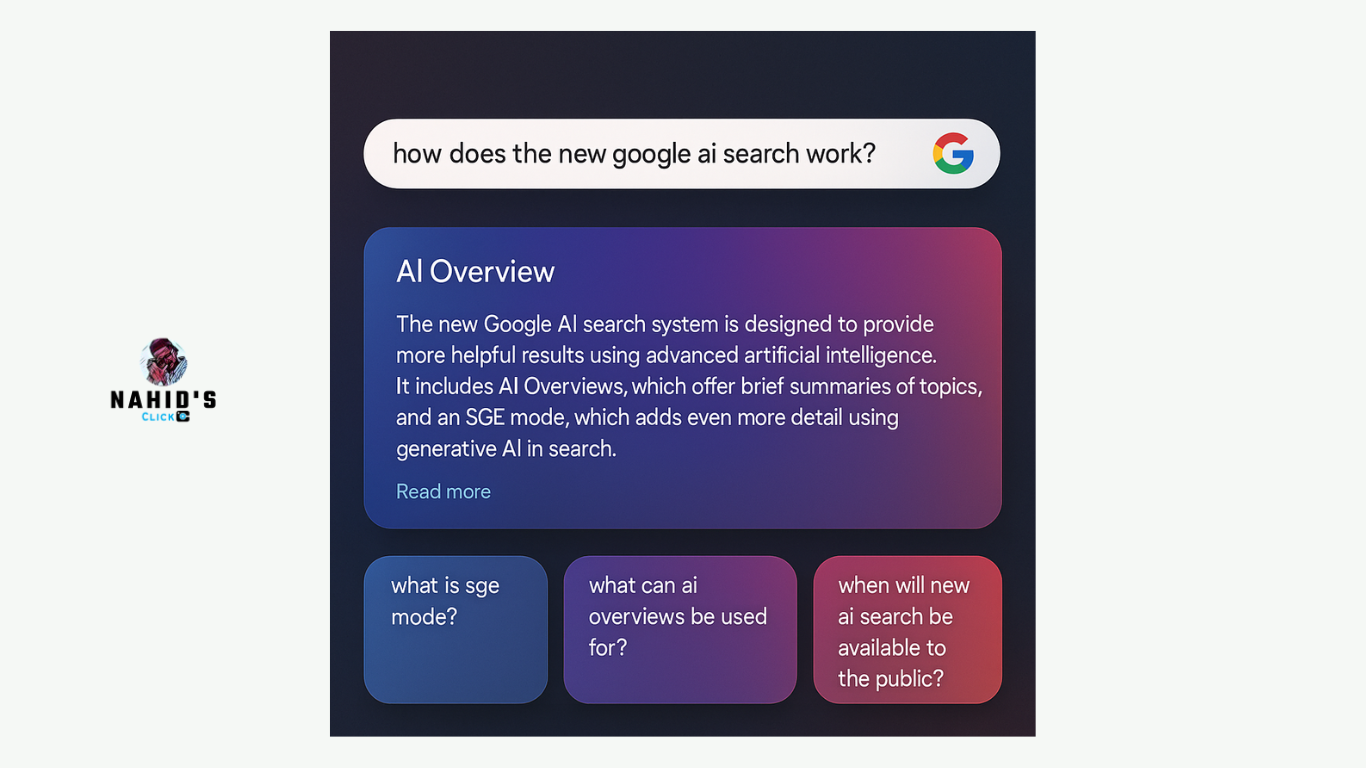
SGE (Search Generative Experience) was Google’s first AI-powered search system that generated summarized answers directly on the search results page — launched as a Labs experiment in 2023. It has since evolved into what Google now calls AI Overviews, which is the default experience for billions of users worldwide.
Here’s how it worked (and still works in its evolved form):
- You search: “Best project management tools for teams under 10.”
- Instead of just blue links, Google shows a rich AI box with a summary, pros/cons, follow-up questions, and source links.
- Only 2–4 sources get cited. If you’re not one of them, your content may not get seen — even if you rank on page 1.
The terminology shift: “SGE” is effectively retired. Google now uses AI Overviews for the answer-box feature and AI Mode for the full conversational search experience. But the underlying principle is the same — AI generates the answer; your job is to be the source it cites.
What is Google AI Overview, and how does it work?

Google AI Overview is the AI-generated answer box that appears at the top of Google search results. It synthesizes information from multiple high-quality sources, reasons across subtopics, and delivers a single structured response — without requiring users to click through to individual websites.
It’s no longer experimental. As of 2026, AI Overviews appear for the majority of informational and navigational queries globally.
1. Expanded AI Overviews

The default AI Overview behavior: summarizes top content from the web and presents it as a rich answer box with cited sources, follow-up prompts, and related questions.
Example query: “How does semaglutide work?”
AI Overview delivers: mechanism of action, dosage context, pulled from verified medical sources like diabetes.org.uk and NIH — all before a single organic link.
2. Deep reasoning and multi-step queries

AI Mode handles layered, complex queries by breaking them into subtopics using a query fan-out technique — searching each sub-question independently and combining the best answers.
Example query: “Compare hybrid cars under $40,000 with good resale value and high fuel economy.”
Google breaks this into: best hybrids under $40K, top fuel economy cars, resale value data — then combines it into one rich answer with specs, pros/cons, price ranges, and review sources.
This is your opportunity to create comparison content that’s deeper and more structured than your competitors. AI cites the most thorough source, not just the most popular one.
3. Conversational mode (chat-style search)

You can now talk to Google like a chatbot — it remembers context across follow-up questions within the same session.
Example:
You: “Best freelance websites for designers” → Google lists Fiverr, Toptal, 99designs
You: “Which one has the lowest fees?” → Google breaks down platform fee comparisons
You: “Show alternatives for beginners” → Google adds Upwork, Behance
As of I/O 2026, this conversational flow works seamlessly across desktop and mobile, worldwide.
4. Live visual search with Google Lens

Point your phone at any object and ask Google about it in real time. Now fully integrated into AI Mode via Google Lens and Project Astra.
Example: Point your phone at your bike gears. Ask: “How do I fix this clicking noise?” Google responds with diagnostic steps, video tutorials, and product recommendations.
5. Agentic capabilities (Now live)

This is no longer “coming soon.” Agentic capabilities are live in Google AI Mode.
AI Mode can now help you complete tasks — compare options, fill out forms, and take action — directly from the search interface. Service businesses need schema markup, fast pages, and structured data to be compatible with this experience.
6. Personalized search (with consent)
If users opt in, Google tailors results using Gmail, Calendar, and past searches.
Example query: “Best time to travel to Malaysia”
Google checks your calendar, suggests dates you’re free, events happening in Malaysia, and flight deals matching your travel history.
What is Google AI Mode? (And how it’s different from SGE)

While AI Overviews summarize search results, Google AI Mode is a full conversational search interface — Google’s answer to ChatGPT, built directly into search. It uses Gemini 3.5 Flash (the default model as of I/O 2026) to deliver personalized, multi-modal, and agentic results.
AI Mode is now available globally — no longer limited to the US.
1. Conversational interface
Type or speak multi-step natural language queries and get chat-style responses with full context retention across the thread.
2. Visual and multimodal input
The new AI-powered Search box (I/O 2026’s biggest announcement) accepts text, images, files, videos, and Chrome tabs as inputs. It dynamically expands to give you room to describe exactly what you need.
3. Powered by Gemini 3.5 Flash
Gemini 3.5 Flash is now the default model in AI Mode for all users. It’s the first in Google’s Gemini 3.x series — combining frontier intelligence with agentic speed, outperforming Gemini 3.1 Pro on challenging coding and agentic benchmarks.
Why does AI Mode matter for SEO?

AI Mode is the future front door to Google. When people stop typing short queries and start having conversations with Google, the rules change:
- You need to optimize for conversational search, not just keyword queries.
- Your content must answer tasks, not just match keywords.
- It must be structured so AI Mode can reference it confidently.
AI Mode doesn’t just link to your blog — it talks about your blog. If your content helps answer tasks like “Help me compare SEO tools” or “How do I build a personal website,” you might be included in the AI thread without needing to rank traditionally.
What’s new in Google AI Mode at I/O 2026?
Google I/O 2026 (May 2026) was the biggest search announcement in years. Here’s what changed:
1 billion users in one year
AI Mode surpassed 1 billion monthly users just 12 months after its debut. Queries are more than doubling every quarter. This isn’t a side feature — it’s the primary search experience for a growing majority of users.
Biggest Search box upgrade in 25 years
Google completely reimagined the Search box — the most fundamental piece of the product in over two decades. It now accepts multimodal input: type, speak, upload images, share files, paste video links, or share a Chrome tab. It dynamically expands to give you more space to describe complex needs.
Search Agents — now live
Google has entered what it calls the “era of Search agents.” Users can now create, customize, and manage multiple AI agents directly in Search.
Information Agents are the first type: they operate in the background 24/7, continuously scanning the web, reasoning across sources, and notifying you when something relevant surfaces — without you needing to search again.
Examples of what Information Agents can do for you:
- Apartment hunting? Dump your exact requirements and the agent scans listings continuously, notifying you when matches appear.
- Following athlete news? Get notified the instant a sneaker collab drops — before it sells out.
- Tracking competitors? Set an agent to monitor brand mentions, product launches, or pricing changes.
Information Agents launch first for Google AI Pro and Ultra subscribers in summer 2026.
Deep Research Agent
The Deep Research Agent handles complex, long-running research tasks. It iterates across multiple searches, reads sources deeply, and synthesizes findings into a comprehensive report — typically taking several minutes for thorough tasks. Think of it as a research assistant that does the work you’d spend hours on.
Seamless AI Overview to AI Mode flow
Users can now ask a follow-up question directly from within an AI Overview and flow naturally into a full AI Mode conversation — with context preserved throughout. This is live globally on desktop and mobile.
SEO in the AI era: What’s changed and why it matters
Google flipped the game board. Before 2023, SEO was mostly about ranking on page 1, winning featured snippets, and getting clicks from ten blue links. With AI Overviews and AI Mode now the default experience, the rules have completely changed.
Old SEO vs. AI-powered SEO in 2026
| Old SEO | AI-Powered SEO (2026) |
|---|---|
| Focused on ranking pages | Focused on being referenced in AI answers |
| Optimized for keywords | Optimized for entities and intent |
| Won with backlinks and keyword density | Wins with structure, clarity, and schema |
| Targeted snippets and PAA boxes | Targets AI Overviews and agent citations |
| CTR depended on position | CTR depends on AI citation depth and trust |
| Write for readers | Write for both readers and AI summarizers |
1. Why clicks are no longer guaranteed
AI Overviews appear at the very top of the SERP and give users summarized answers with follow-up questions and links to only 2–4 chosen sources. If your content isn’t cited, your organic rank may be irrelevant.
Example: Query: “How to install a WordPress plugin”
AI Overview shows a step-by-step summary with a screenshot and only 2 links visible above the fold. If you’re not one of those 2, you’re invisible for that query.
2. Google understands more than keywords
Gemini 3.5 Flash understands relationships between topics (entities), context across queries, and the intent behind each search. Old tricks like exact-match keywords in H1 and URL aren’t enough anymore.
What works in 2026: using related terms (e.g., “AI Overview,” “query fan-out,” “Gemini model,” “Search Agent”), adding real answers rather than keyword stuffing, covering subtopics and comparisons in depth.
3. Structured data is more important than ever
For AI Overviews to cite you, your content needs to be machine-parseable. That means:
- Clear H2s and H3s for each topic
- Bullet points for lists and features
- Bold definitions at first use
- Schema markup (FAQPage, HowTo, QAPage)
4. Thin content is now invisible
AI-spun posts, outdated how-tos, and content that repeats what everyone else says? Google’s AI search skips them. AI Overviews look for accuracy, depth, original insights, and entity relevance. Your content must deserve to be cited — not just exist.
Instead of: “5 SEO Tips for 2026” (generic)
Write: “How Google’s Query Fan-Out Works — With Real Examples and What It Means for Your Content” (specific, citable, original)
5. Think like an AI when creating content
Ask yourself before publishing: Is my content easy to summarize? Would AI confidently cite it? Does it offer original insights worth referencing? If yes — you’re doing SEO the right way in 2026.
How to future-proof your content for Generative Engines (GEO)

GEO (Generative Engine Optimization) is the process of optimizing your content so AI engines — ChatGPT, Perplexity, Bing Copilot, Claude, and Google AI Mode — can find, read, summarize, and cite it in their responses.
These tools don’t just link to websites. They read your content, summarize it, and use it in their answers. If you’re not thinking about GEO, you’re already behind.
1. Write for AI summarizers, not just readers
Generative engines look for clear answers, structured formatting, semantic consistency, and factual accuracy.
Instead of: “When it comes to search engine optimization in the modern digital age, strategies are shifting.”
Write: “GEO (Generative Engine Optimization) is the process of optimizing content for AI tools like ChatGPT, Perplexity, and Google AI Mode so they cite your content in their answers.”
2. Cover the entire topic, not just the keyword
GEO engines reward topical depth. Go beyond keyword coverage. Address the who, what, when, why, and how. Link to supporting topics internally and externally. Build entity authority that LLMs trust.
If your topic is “best project management tools,” also include: how to choose one, pricing breakdowns, tools by use case, and pros/cons comparisons. This is what large language models love.
3. Use semantic SEO and structured content
To get AI engines to understand your content, use semantically related terms (e.g., “Google AI Mode,” “AI Overview,” “Gemini model,” “query fan-out,” “Search Agent”), logical structure (H2s, bullets, definitions), and clear context for each section.
For a deep dive on planning and clustering your content for topical authority, see How to Plan 100+ Blog Posts Using Topic Clusters.
4. Answer questions like a human — clearly
GEO engines are answer engines. The better you answer a question, the more likely you are to be featured. Try this format:
- Ask the question as an H2 or H3
- Answer in 1–2 bolded sentences immediately after
- Follow up with supporting info, examples, or stats
Example:
Q: What is a Google Search Agent?
A: A Google Search Agent is an AI that operates in the background 24/7, continuously monitoring a topic or task and delivering relevant insights without requiring repeated manual searches.
5. Add original value — charts, tables, quotes
GEO engines reward unique content. Not rewrites. Add custom visuals (comparison tables, pricing charts), expert insights, FAQs with schema markup. Instead of reusing someone else’s pros/cons list, create your own table based on use case: freelancer vs. agency vs. product team. That’s what Perplexity links to — not copycat content.
6. Use citations and factual accuracy
GEO tools favor pages with linked sources, fresh fact-checked content, and trust signals (author bios, publication dates with update history). Want ChatGPT or Perplexity to quote you? Give them something verifiable.
7. Think beyond the blog
GEO success also comes from well-structured docs, help articles, landing pages with question-based headers, and product comparison pages. Treat every content asset like it might become an AI answer. Because it might.
Tools that help with GEO
- Also Asked — find long-tail queries and question clusters
- Semrush / Semdash — build semantic content clusters
- Perplexity — check what AI currently cites for your keyword
- LLMRefs — see how LLMs are citing your brand across different AI tools
- ChatGPT (with Browse) — ask where it pulls info from for your topic
- Free Google SEO Tools — Google’s own suite for foundational SEO data
I’ve also been experimenting with connecting GA4 and GSC directly to Claude Desktop via MCP — which lets you analyze which of your pages are getting AI citations and where your content gaps are. Highly recommend that workflow if you’re serious about GEO.
Examples of Google AI Mode in action

Here’s what Google AI Mode actually looks like across different query types — and what your content needs to do to be featured.
1. How-to query — “How to start a podcast for free”
AI Mode result:
- AI summary listing 5 steps: choose a niche, use free software (Audacity, Anchor), record and edit, create cover art, publish on platforms
- Direct links to tutorial blogs and platforms
- Button: “Compare free podcast tools”
What got cited: step-by-step formatting, clear tool names, actionable content, FAQ or schema markup.
2. Health and science — “How does intermittent fasting work?”
AI Mode result:
- AI explanation (2–3 paragraphs)
- Summary of fasting methods (16:8, 5:2)
- Benefits and risks
- Sources cited: Healthline, NIH, medical journals
3. eCommerce + visual — “Best minimalist watches under $300”
AI Mode result:
- Grid of 4–6 watches with photos
- Quick features: price, brand, water resistance
- Sources include product pages, review sites, and Reddit threads
Key patterns across query types
| Query Type | What AI Mode Looks For | What You Should Include |
|---|---|---|
| Comparisons | Side-by-side features, pricing, visuals | Tables, lists, pros/cons |
| How-To | Step-by-step, tools, screenshots | Clear headings, checklists |
| Definitions | Concise summaries, sources | Bolded answers, citations |
| Local queries | Reviews, schema, location data | Google Business + structured content |
| eCommerce | Specs, reviews, user insights | Images, unique data, roundup format |
Challenges, concerns, and what experts are saying
The rise of AI Overviews and Google AI Mode isn’t just exciting — it’s raising serious concerns in the SEO, publishing, and creator communities. Let’s be honest about it.
1. Impact on traffic and publishers
AI Overviews give users answers before they click. That’s efficient for searchers — but tough for content creators. Google summarizes your content on the SERP, links to only 2–4 sources, and users spend more time in the AI thread and less time on your site.
“SGE could dramatically reduce organic traffic for informational queries — especially when users don’t need to click through to learn more.” — Barry Schwartz, Search Engine Roundtable
“Publishers are already struggling with declining visibility. If AI Overviews become permanent, we need new models for monetization and attribution.” — Lily Ray, Amsive Digital
If your content doesn’t provide more than what AI can summarize, it may never get seen.
2. Accuracy, hallucination, and AI bias
Generative AI is powerful — but it’s not perfect. Google’s AI Overviews have surfaced inaccurate summaries, outdated data, and in early 2024, some dangerous medical recommendations. The famous “eat one small rock per day” hallucination (pulled from satirical Reddit content) went viral and exposed a critical flaw in AI summarization.
“Generative AI is only as good as the content it’s trained on. Biases, misinformation, and hallucinations are still major risks — especially in YMYL topics.” — Marie Haynes, E-E-A-T Researcher
3. Content ownership and credit
AI Overviews often pull snippets from multiple sites, combine them without attribution, and don’t always show direct links. The question of who owns the content that AI summarizes — and whether creators should be compensated — remains unresolved.
“We’re doing all the work — and Google is getting all the traffic.” — Anonymous publisher, Search Engine Land
“If AI becomes the interface to content, creators must be part of the value chain — or the system becomes exploitative.” — Rand Fishkin, SparkToro
Bottom line: SEO is evolving, not dying. Helpful, well-structured, trustworthy content still has a strong future. But you have to write for both humans and machines.
What does Google AI mean for the future of search optimization?

SEO is no longer about chasing keywords. It’s about being part of the answer. With AI Overviews, AI Mode, and Search Agents now shaping the default search experience, here’s how the game is evolving.
1. AI Overviews and Search Agents are permanent
These are no longer experiments. AI Overviews are the default. Search Agents are the next layer — running continuously in the background for subscribed users. Traditional rankings are being supplemented by AI-powered summaries and topical references. If you’re not structured, cited, or semantically deep, you’re invisible.
2. Content marketing = task solving
Stop writing “Top 10 SEO Tools.” Start writing: “Help me choose the best SEO tool for a local bakery” — and answer every variation of that question. AI Mode loves intent-rich, help-first content that solves tasks, not just answers keyword queries.
3. SEO success = structured, semantic, strategic
The basics still matter. On top of that, add:
- Structure your content like AI reads it (H2s, bullets, bolded answers)
- Use semantic SEO (related entities, concepts, and context)
- Think in clusters, not just posts — pillar pages + supporting content is the architecture AI trusts
4. AI-first optimization is the new normal
- Format for machines (schema, FAQs, visual aids)
- Write for summarizers (clear, quotable blocks)
- Think like a product manager — what does the user actually want to accomplish?
If you’re not AI-referenceable, you’re not SEO-ready.
5. Be citable, not just rankable
You don’t need to be #1. You need to be referenced. That’s how you get cited in AI Overviews, featured in Perplexity, embedded in AI Mode threads, and picked up by Search Agents. Citeability is the new authority signal.
In short: How to optimize for Google AI search (AIO, AEO, GEO)
AIO (AI Overview Optimization)
- Use clear, bold definitions AI can easily quote
- Add structured data:
FAQPage,HowTo,Product - Create original comparisons and list-style content with visuals
AEO (Answer Engine Optimization)
- Use question-based headers (e.g., “What is Google AI Mode?”)
- Answer in 40–60 word summaries immediately after the heading
- Include step-by-step lists and refresh content every 3–6 months
GEO (Generative Engine Optimization)
- Write long-form, in-depth content with clear structure
- Include expert quotes and unique visuals
- Use citations and build content clusters for topical authority
Think like an AI reader: structure your content for clarity, context, and confidence — and you’ll win in every SERP format.
Frequently asked questions about Google AI Mode, AIO, AEO, and GEO
Can I ask follow-up questions in Google AI Mode like I do in ChatGPT?
Yes. Google AI Mode uses a conversational interface that remembers context within a session. You can refine your queries with follow-up questions and Google will respond with progressively more personalized answers — similar to ChatGPT but powered by Gemini 3.5 Flash and grounded in live web data.
How does Google decide which sites to cite in AI Overviews?
Google prioritizes well-structured, authoritative content that directly answers the query. It looks for semantic relevance, structured data, original insights, and clear entity signals. Being cited is less about ranking and more about being reference-worthy. High E-E-A-T, clear definitions, and schema markup all help.
What are Google Search Agents and how do they work?
Google Search Agents are AI-powered assistants you create and manage directly in Search. They operate 24/7 in the background — continuously monitoring topics, scanning the web, and surfacing relevant information when it’s needed, without you having to search again. Information Agents are the first type, launching for Google AI Pro and Ultra subscribers in summer 2026.
What is Google’s query fan-out and why does it matter for SEO?
Query fan-out is the process where Google breaks a complex search query into multiple sub-queries, searches each independently, and combines the best answers into a single AI Overview. For SEO, your content should cover related subtopics and angles — not just the main keyword — to be considered for inclusion across multiple sub-queries.
What is the difference between SGE, AI Overviews, and AI Mode?
SGE (Search Generative Experience) was the original name for Google’s AI-powered search experiment, launched in 2023. AI Overviews is what that feature became when it launched globally — the AI answer box at the top of search results. AI Mode is the full conversational search interface that goes deeper: multi-turn conversations, Search Agents, multimodal input, and agentic task completion. Think of them as three generations of the same evolution.
Is Google AI Mode available globally?
Yes. As of 2026, Google AI Mode is available globally on desktop and mobile. It was previously limited to the US during its initial rollout.
Can Google AI Mode complete tasks like booking or shopping?
Yes — agentic capabilities are now live in AI Mode. Google AI can compare options, help fill out forms, and assist with completing tasks like booking tickets or shopping. Full autonomous task completion is expanding progressively across regions and use cases.
Conclusion: Don’t fight the future — rank with it
Search has changed permanently. Google isn’t just a list of links anymore — it’s an answer engine, a conversation partner, a research assistant, and now, a 24/7 background agent.
Whether it’s AI Overviews, AI Mode, or Search Agents — one thing is clear:
You don’t just need to rank. You need to be reference-worthy.
That means structuring content like a machine can read it, writing like a human would ask for it, and adding insights that make AI say, “Yes — I’ll cite that.”
The brands, blogs, and creators who adapt to this AI-first world won’t just survive. They’ll own the top of the SERP — even if the SERP doesn’t look like a list anymore.

Nahid Komol
Nahid Komol is a product marketer and GTM strategist specializing in WordPress, SaaS, and AI-integrated growth (AEO, AIO, GEO). With 10+ years of hands-on experience at brands like FunnelKit, FlyWP, and weDevs, he brings deep expertise in content strategy, product positioning, user acquisition, and full-funnel marketing.He's led campaigns generating $100K in sales, grown organic traffic by 70%, and ranked 500+ articles on Google, and is now building AI agent workflows that automate core marketing operations at scale.When he's not crafting strategies or engineering prompt systems, you'll find him exploring sci-fi, composing music, or capturing the quiet poetry of nature through his lens.
Comments are closed