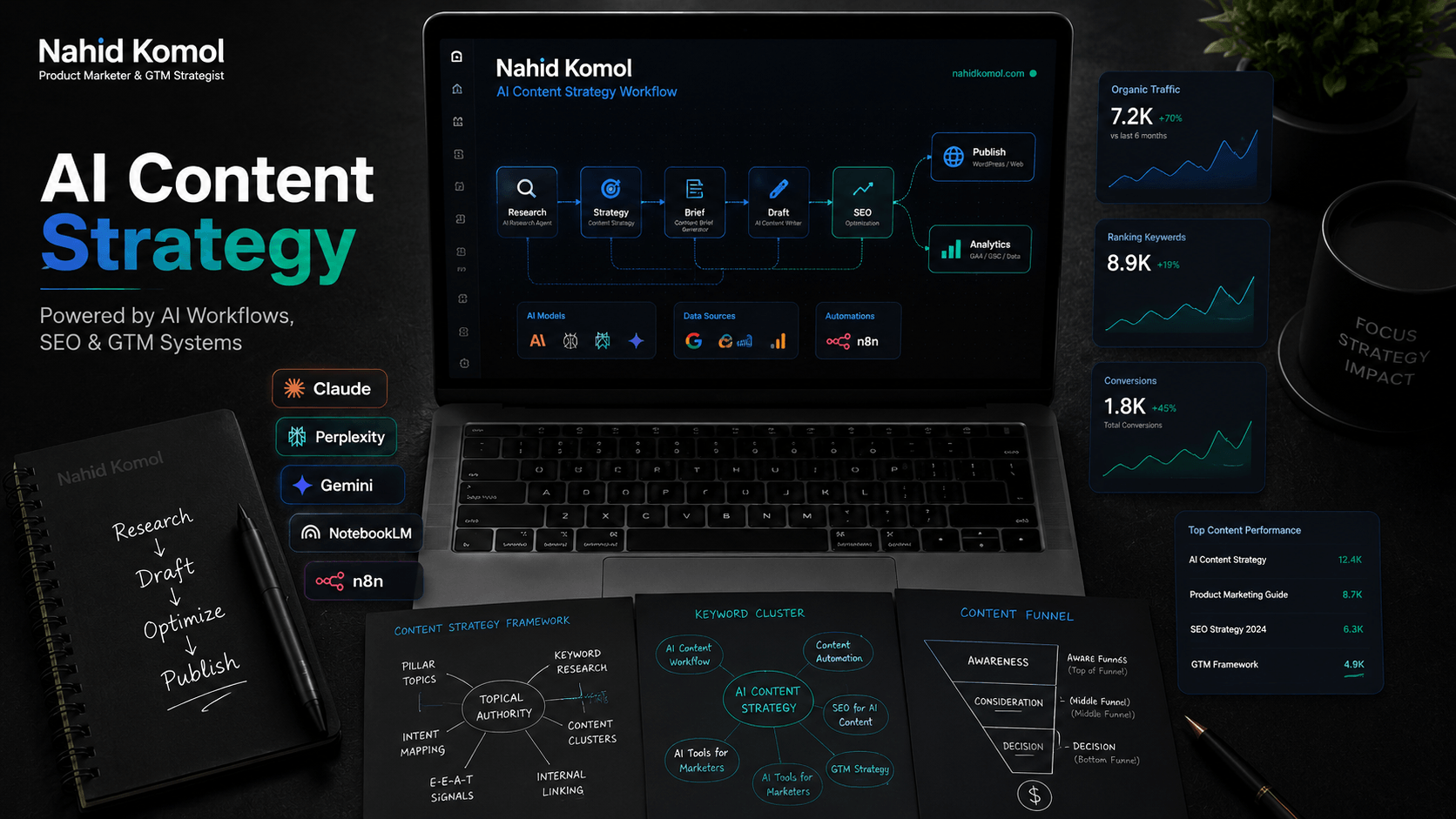
My AI Content Strategy: The Exact Stack, Process, and Client Results That Work in 2026
Most marketers use AI to write faster. I use it to think better.
There is a difference. Faster means more output. Better means more outcomes, higher rankings, stronger positioning, client revenue that actually moves. I have grown organic traffic by 70% in six months, managed 700+ articles for one company, and run a $100K GTM campaign. None of that happened by pasting prompts into ChatGPT and hitting publish.
Here is my actual AI content strategy: the stack I run, the process I follow phase by phase, and what it has produced for me and for the clients I work with.
What Is an AI Content Strategy?
Definition
An AI content strategy is a structured approach to planning, creating, optimizing, and distributing content using artificial intelligence tools at specific stages of the workflow. It is not about replacing human judgment — it is about making that judgment faster and better-informed at every stage.
The key distinction is where AI fits. AI handles research synthesis, outline structuring, draft generation, and optimization passes. The human handles the angle, the proof, the perspective, and the editorial filter that makes the content worth reading. Remove the human layer and you get content that sounds like everyone else’s AI content. Keep it, and you get something that actually ranks, resonates, and converts.
Why Most AI Content Strategies Fail
Two failure modes appear in almost every marketing team I have worked with or advised:
Two Failure Modes to Avoid
Failure Mode 1: Using AI to write without using AI to think first. The output looks like content. It reads like nothing. No angle, no proof, no reason for the reader to trust it.
Failure Mode 2: Publishing AI content with no human editorial layer. It hits every keyword. It ranks for a week. Then it tanks because Google’s helpful content systems reward expertise, experience, and originality — none of which come from a prompt alone.
The fix is not less AI. The fix is a workflow where AI and human judgment each do what they are actually good at.
My AI Content Stack
I do not use every tool on every piece. The stack scales to the job. A LinkedIn post is Claude only. A full client content strategy brief is Perplexity plus NotebookLM plus Gemini plus Claude.
Here is what each tool does in my workflow:
Claude (Anthropic)
Primary thinking partner. Research synthesis, outline generation, draft writing, SEO and LLM optimization, MCP-powered workflows. My most-used tool by volume.
Perplexity
Real-time research. Current data, competitor content analysis, source verification, and emerging angle discovery. What Google used to do, faster.
n8n
Automation layer. 8-agent content factory that handles research, summarization, gap analysis, and draft prep. Turns 3-hour research sessions into 12-minute runs.
Gemini
Long-context analysis. Processing full research PDFs, brand documents, and competitive reports that exceed Claude’s context window.
NotebookLM
Source synthesis. Feed 10 research PDFs or articles and get one structured brief. Excellent for client onboarding research and industry deep dives.
DeepSeek + Genspark
Alternative drafting for cost-sensitive or high-volume workflows. Strong at structured output and fast iteration when you need multiple versions quickly.
Google Search Console sits underneath all of this as the reality check. No AI tool tells me what my specific audience is actually searching for. Connecting GSC and GA4 directly to Claude via MCP changed how fast I can move from data to insight to content plan.
Phase 1: Research and Planning
Before I write a single word, I need four things confirmed:
- What the target keyword is and what the current top 3 results actually say
- What question the reader is really asking (not just what they typed)
- What my angle is that the existing results do not cover
- What proof point I can bring that no one else in the results can match
For keyword research, I start with Google Search Console data to find underperforming URLs and hidden opportunities — pages already getting impressions but low clicks. Then Perplexity to understand what the current search results are actually saying. Then I cross-reference with free Google SEO tools like Search Console’s performance report, Google Trends, and People Also Ask to confirm search intent.
I ask Perplexity: “What are the top 5 articles ranking for [keyword] saying, and what are they missing?” That gap becomes my angle.
From the field
At Arraytics, this research-first process drove 70% organic growth in six months — from 4,100 to 7,000 clicks. Every article started with a GSC gap analysis, not a keyword tool guess. We targeted exact queries the site was already getting impressions for but not ranking on. That one shift moved our content calendar from “topics we think matter” to “questions the audience is already asking.” One blog in that model generated $1,000 in direct revenue.
Phase 2: Content Creation Workflow
Once the brief is locked, here is my step-by-step process:
Step 1: Brief Generation with Perplexity + Claude
I give Perplexity the keyword and three competitor URLs. It comes back with what those articles cover, what claims they make, and what questions they leave unanswered. I paste that into Claude with my positioning angle and ask for a structured content brief with an H2 skeleton and the key point each section needs to make.
Step 2: Outline Review (Human)
I review the brief and make the decisions AI cannot make for me: what to cut, what my angle adds that the AI missed, and where my personal proof points belong. This is the most important step in the whole workflow. If I skip it, the article reads like everyone else’s.
Step 3: Section-by-Section Drafting with Claude
I draft one section at a time, not the full article at once. I give Claude the brief, the section goal, and a tone note. “Write the introduction that opens on the specific tension of [X], max 3 short paragraphs.” Scoped prompts produce tighter output than “write the full article.”
Step 4: Human Editorial Pass
Every draft gets a human pass before it moves forward. I add proof points from my own work, opinions I actually hold, examples I have seen in practice, and the lines that make it sound like me rather than a model. This is where the article becomes worth reading.
Step 5: SEO and LLM Optimization
After the draft is solid, I run a two-layer optimization pass: traditional SEO and LLM optimization. More on the second layer in the next section.
How n8n Fits In
I have automated Steps 1 and 5 in n8n using an 8-agent content factory. The Research Planner agent pulls keyword context, the Web Scraper hits the top-ranking pages, the Summarizer extracts what they say, and the Gap Checker flags what they miss. That research pass used to take 2 to 3 hours per article. The automated version runs in about 12 minutes. The human judgment steps — outline review and editorial pass — stay manual. Those are the steps that produce differentiation.
Phase 3: SEO and LLM Optimization
These are two separate layers, and most marketers only work on one.
Traditional SEO
The primary keyword appears in the H1, within the first 100 words, in at least two H2s, the meta title, and the meta description. Internal links connect the article to related content on the same domain. Page speed is clean. Schema markup is in place for FAQ sections. This is table stakes, and it is not optional.
LLM Optimization (GEO and AEO)
This is where the real opportunity sits in 2026. AI search systems, Google AI Mode, Perplexity, Claude, ChatGPT — are now surfacing content in their answers. To get cited rather than skipped, your content needs four things:
- A clear definition block early in the article — something an AI can lift and quote as the direct answer
- FAQ sections with direct, specific answers — not hedged, not vague, not “it depends” without an actual answer following it
- Named, specific proof — company names, numbers, outcomes. AI systems prefer citable evidence over generic claims
- A clear author perspective — something that distinguishes the content from the generic version of the same answer
The structure of this article follows those principles. The definition box at the top exists so AI systems can cite a clean answer. The FAQ at the bottom exists because People Also Ask and AI overviews pull directly from well-structured Q and A content.
Worth Reading
If you want to understand how AI search systems are now serving content and what it means for your strategy, my complete guide to Google AI Mode covers the mechanics, the GEO implications, and what you need to change in how you structure articles.
Phase 4: How I Apply This for Clients
The same stack and workflow applies when I am working for a brand. Two things change:
- I replace my personal proof points with the client’s product data, customer stories, and internal knowledge I gather in onboarding
- Every AI output runs through their brand voice constraints before delivery — tone guidelines, banned phrases, preferred vocabulary, and 3 examples of content that sounds like them
The brand voice comes first. The AI speeds up what comes after.
From the field: weDevs
At weDevs, I managed 700+ articles across four products and ranked 500+ pages in Google search. The content that outperformed everything else was the content where I fed AI a real customer problem I had heard in support tickets, asked it to help structure an answer, then wrote the actual answer myself. The AI did the scaffolding. I did the thinking. One piece in that model generated $2K in direct revenue and earned 20+ Featured Snippets. The reason it worked was that the insight came from actual customer pain — something no competitor and no AI could replicate without access to those same conversations.
From the field: ZOYEQ
At ZOYEQ, I built the content and GTM strategy from scratch for an AI-powered eCommerce platform targeting SME merchants. The January 2026 launch campaign used AI to accelerate every production step: copy variations, landing page testing, email sequences, and ad creatives. But the positioning, the customer message, and the campaign angle came from human research done in the weeks before launch. That campaign brought in $100K in revenue and 2,000+ customers. AI gave us speed. Strategy gave us direction. You need both.
For eCommerce clients specifically, the content strategy connects directly to proven eCommerce growth strategies — where content is not just SEO infrastructure but a direct acquisition channel.
Results at a Glance
70%
Organic traffic growth at Arraytics in 6 months
700+
Articles managed and 500+ SERP-ranked at weDevs
$100K
Revenue from ZOYEQ January 2026 GTM campaign
$2K
Revenue from a single content piece at weDevs
Frequently Asked Questions
What is the best AI tool for content strategy?
There is no single best tool — the combination matters more than any individual product. Claude is my primary thinking partner for planning and drafting. Perplexity is my research tool for live data and competitor analysis. n8n is my automation layer. Start with Claude for planning and drafting, add Perplexity for research, and build automation only after your manual workflow is solid.
Can AI replace a content strategist?
No. AI can accelerate research, drafting, and optimization. It cannot determine which topics to pursue, what angle makes a brand distinctive, or how to embed the insider proof that makes content trustworthy. The strategist’s job has shifted from writing to directing. That is a better job, not a smaller one.
How do I optimize content for AI search systems like Perplexity and Google AI Mode?
Structure is what matters most. Include a clear definition near the top of the article. Use FAQ sections with direct, specific answers. Name companies, numbers, and outcomes rather than speaking in generalities. Include a perspective that is identifiably yours rather than the generic version of the answer. For the full breakdown, see my guide on how Google AI Mode works and what it means for your content.
How long does it take to build an AI content workflow?
The basic stack — Claude plus Perplexity plus a structured prompt library — takes a few days to set up and a few weeks to refine into a repeatable process. The n8n automation layer adds setup time but compounds returns significantly once it is running. Start manual, identify the most repetitive steps, then automate those first.
Does AI-assisted content rank on Google?
AI-assisted content with a strong human editorial layer does rank, and ranks well. Purely AI-generated content with no human pass typically holds rankings for a short period then drops. Google’s helpful content systems are designed to reward expertise, experience, authority, and trust — all of which require a human layer to demonstrate. The workflow above is designed specifically to keep that layer in place at every stage.
How do you maintain brand voice when using AI for client content?
Brand voice documentation comes before any AI prompt. I build a voice reference that includes tone guidelines, banned phrases, preferred vocabulary, and three examples of content that sounds correct for that brand. Every AI output runs through that filter before delivery. AI produces the draft at speed. The brand voice filter determines whether that draft is usable. Getting psychological marketing principles embedded into the brand voice brief also makes the final content significantly more effective at driving conversions.
Ready to Scale Content With AI Without Sacrificing Quality?
This is the same AI content framework I use to create content, streamline workflows, improve SEO performance, and help SaaS businesses generate qualified leads. If you want to discuss AI content strategy, GTM planning, content operations, or marketing automation, let’s talk.

Nahid Komol
Nahid Komol is a product marketer and GTM strategist specializing in WordPress, SaaS, and AI-integrated growth (AEO, AIO, GEO). With 10+ years of hands-on experience at brands like FunnelKit, FlyWP, and weDevs, he brings deep expertise in content strategy, product positioning, user acquisition, and full-funnel marketing.He's led campaigns generating $100K in sales, grown organic traffic by 70%, and ranked 500+ articles on Google, and is now building AI agent workflows that automate core marketing operations at scale.When he's not crafting strategies or engineering prompt systems, you'll find him exploring sci-fi, composing music, or capturing the quiet poetry of nature through his lens.
Comments are closed